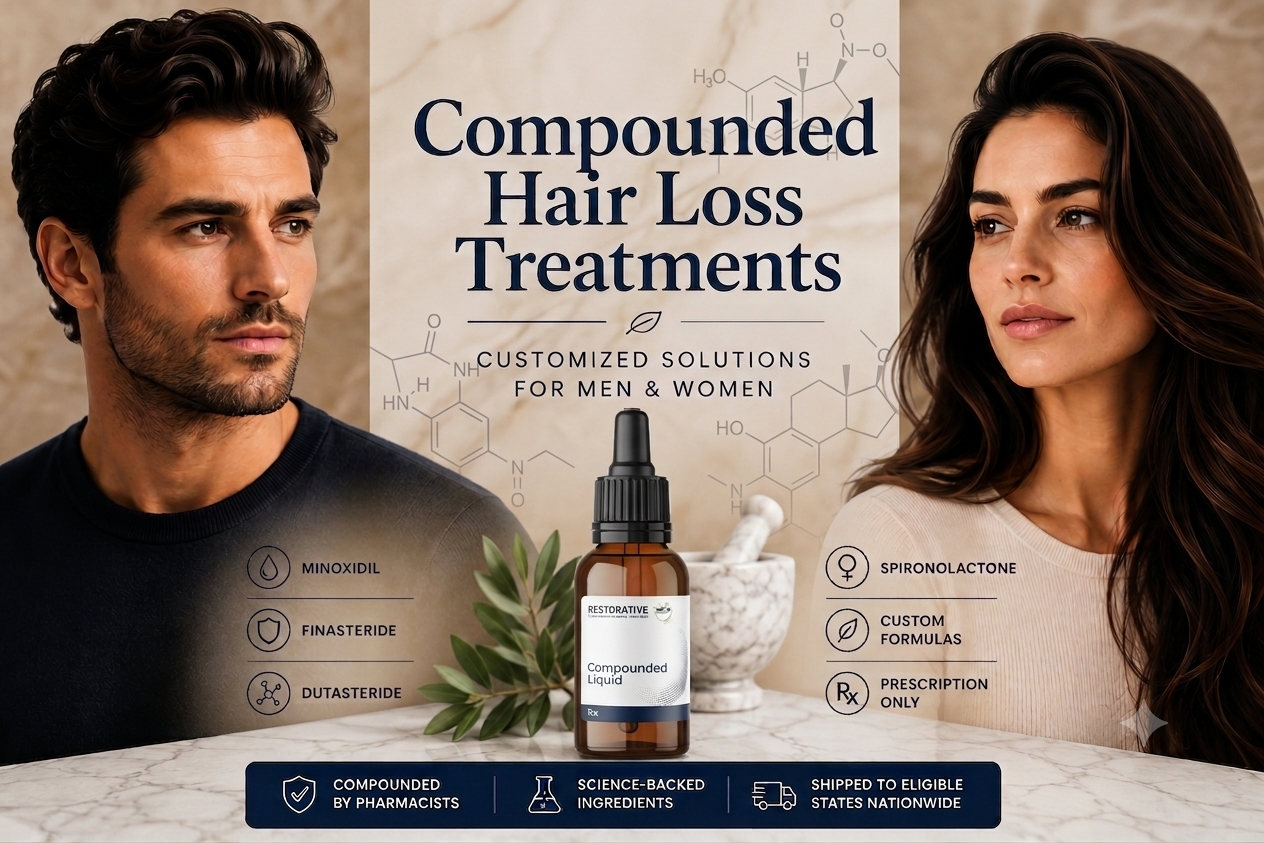
Summary: Compounded hair loss treatments combine multiple proven ingredients — such as minoxidil, finasteride, dutasteride, spironolactone, latanoprost, progesterone, tretinoin, fluocinolone, ketoconazole, azelaic acid, caffeine, biotin, and GHK-Cu — into a single prescription formula (a scalp solution, oil, or capsule) tailored to your specific type of hair loss. Instead of layering several separate products, a compounding pharmacy prepares one preparation at strengths your prescriber chooses, which can simplify your routine and, in the case of topical formulas, may limit whole-body absorption compared with oral versions.
Hair loss is one of the most common concerns we compound for — in both men and women. Below, our pharmacist explains how these formulas work, what’s inside them, and how the male and female approaches differ.
What causes pattern hair loss?
Most pattern hair loss — known medically as androgenetic alopecia — is driven by a hormone called dihydrotestosterone (DHT). In genetically susceptible people, DHT gradually shrinks (miniaturizes) hair follicles, so hairs grow back finer, shorter, and eventually not at all. This is why many effective treatments work by either stimulating the follicle (minoxidil), reducing DHT (finasteride, dutasteride), or blocking androgen activity (spironolactone, used in women).
How compounding targets the biology of hair loss
Hair loss isn’t one problem — it’s several overlapping ones happening at the follicle at the same time. That’s why a single over-the-counter product often falls short, and why compounding is useful: a prescriber can address several mechanisms in one preparation. The main targets are:
Lowering DHT at the follicle. In androgenetic alopecia, DHT drives follicle miniaturization; finasteride and dutasteride inhibit the 5-alpha-reductase enzyme that produces it. (Int J Mol Sci)
Restarting and extending the growth (anagen) phase. Minoxidil prolongs anagen and helps reverse miniaturization, coaxing resting follicles back into growth. (Dermatologic Therapy)
Improving blood flow to the follicle. Minoxidil is a vasodilator that increases blood supply to the follicle and is linked to growth-factor (VEGF) activity.
Blocking androgen activity in women. Spironolactone blocks androgen receptors — an approach frequently used in female-pattern hair loss.
Boosting how well actives absorb. Tretinoin can up-regulate the follicular sulfotransferase enzyme that activates minoxidil, improving response. (Dermatologic Therapy)
Calming scalp inflammation. Low-grade inflammation contributes to hair loss; adjuncts such as azelaic acid or a low-dose topical steroid can help reduce it.
A compounded formula lets your prescriber pull several of these levers at once — for example, a minoxidil-and-finasteride solution with tretinoin — in one product tuned to your pattern of loss.
How do compounded hair loss treatments work?
Here’s what the common ingredients do:
Minoxidil — stimulates and prolongs the hair-growth phase and improves blood flow to the follicle. Use: men and women. FDA status: approved (topical) for hair loss.
Finasteride — blocks the enzyme that converts testosterone to DHT. Use: primarily men; select women under supervision. FDA status: approved (oral, for men); topical use is off-label.
Dutasteride — blocks DHT more broadly than finasteride. Use: men. FDA status: off-label for hair loss.
Spironolactone — an anti-androgen that blocks androgen receptors. Use: primarily women. FDA status: off-label for hair loss.
Latanoprost — a prostaglandin analog that can extend the hair-growth (anagen) phase and stimulate follicles; first used for eyelash growth and studied for scalp hair. Use: adjunct. FDA status: off-label for scalp hair loss.
Ketoconazole — an antifungal that also has mild anti-androgen and anti-inflammatory activity on the scalp, helping lower local DHT and calm inflammation. Use: men and women. FDA status: approved antifungal; off-label for hair loss.
Progesterone — has anti-androgen activity and can inhibit the enzyme that produces DHT; often added to women’s formulas. Use: primarily women. FDA status: off-label for hair loss.
Fluocinolone — a topical corticosteroid that calms scalp inflammation, which can contribute to shedding and certain inflammatory forms of hair loss. Use: adjunct. FDA status: approved steroid; off-label for hair loss.
Tretinoin — may enhance minoxidil absorption and follicle turnover. Use: adjunct. FDA status: approved active, used off-label here.
GHK-Cu (Copper Peptide) — a naturally occurring copper tripeptide studied for tissue repair and regeneration; on the scalp it has been shown to enlarge hair follicles and support growth, likely through better follicle blood supply along with antioxidant, anti-inflammatory, and collagen-supporting effects. Use: men and women (adjunct). FDA status: not FDA-approved for hair loss; used as a compounded adjunct.
Biotin, Caffeine & Azelaic Acid — supportive adjuncts often added to combination formulas. Use: men and women. FDA status: varies.
Because these are combined into one scalp solution, oil, or capsule, you apply or take a single product rather than juggling several.
Why choose a compounded formula over off-the-shelf products?
Combination in one product. A single scalp solution can contain minoxidil plus finasteride plus an adjunct — instead of three separate bottles.
Custom strengths. Your prescriber sets the concentration of each active for your needs and tolerance.
Topical instead of oral. Research on topical finasteride shows it can improve hair density with limited systemic absorption, meaning fewer whole-body effects than the oral tablet. (PMC / NIH; systematic review)
Formulated for how you’ll use it. Solutions, oils, foams, or capsules depending on preference and hair type.
What does the research say about compounded topical formulas?
Compounded topical hair-loss formulas are increasingly studied in their own right. A randomized study of a topical minoxidil-and-finasteride solution (combined with biotin and caffeine) reported meaningful improvement in men with androgenetic alopecia (US Pharmacist; PubMed). Separately, a large real-world analysis of men prescribed compounded topical finasteride found high patient satisfaction and a low rate of systemic side effects (PMC / NIH). As always, whether any formula is appropriate — and at what strength — is a decision your prescriber makes for you.
How is hair loss treatment different for women?
Female-pattern hair loss is treated a little differently. Minoxidil is the only FDA-approved topical therapy for female-pattern hair loss, but prescribers increasingly combine it with anti-androgens. A 2025 clinical and trichoscopic study found topical finasteride and minoxidil each produced meaningful improvement in women, and other randomized data support combining minoxidil with spironolactone in women with androgenetic alopecia. (Dermatology Practical & Conceptual / PMC, Journal of Cosmetic Dermatology)
This is exactly where compounding shines: a spironolactone-and-minoxidil scalp solution, or a minoxidil-finasteride-progesterone formula, can be built specifically for female-pattern hair loss — options you can’t buy pre-made.
Example compounded hair loss formulations
Because compounding is customized to the prescription, formulas come in many combinations and delivery forms. Common examples include:
Finasteride/Minoxidil Scalp Solution — the two most-proven actives in one topical
Finasteride/Minoxidil/Progesterone Scalp Solution — adds an anti-androgen, often used for women
Biotin/Finasteride/Minoxidil Capsules — an oral combination approach
Biotin/Minoxidil/Dutasteride Capsules — for stronger DHT blockade
Minoxidil/Latanoprost Scalp Solution — pairs a follicle stimulant with a prostaglandin analog
Azelaic acid/Minoxidil/Triamcinolone Scalp Solution — adds anti-inflammatory support
Fluocinolone/Minoxidil/Tretinoin Scalp Oil — a scalp-oil base with a retinoid to enhance penetration
GHK-Cu Scalp Solution — a peptide formulation for tissue repair and regeneration
Your prescriber selects the combination, strengths, and base that fit your hair-loss pattern, scalp type, and preferences.
What results should I expect, and how long does it take?
Hair growth is slow. Most treatments require at least 3—6 months of consistent use before visible change, and benefits continue only while you keep using the treatment. Early on, some people notice a temporary increase in shedding as follicles reset — this is usually a normal part of the process. Consistency is the single biggest predictor of success.
How do I get a compounded hair loss formula?
Compounded hair loss treatments are prescription-only. Your prescriber determines the right combination and strengths for your situation, sends the prescription to our pharmacy, and we prepare it to their exact specifications and ship it to you.
Why patients trust Restorative: we’re a 503A compounding pharmacy with NABP Healthcare Merchant Accreditation and .pharmacy verification, shipping to eligible states nationwide, with every preparation made by licensed pharmacists to your prescriber’s exact specifications.
Providers: Get set up with Restorative →
Patients: Start a prescription or transfer →
Explore related men’s health compounding →
Frequently asked questions
Is compounded topical finasteride safer than the pill?
Topical finasteride is absorbed far less into the bloodstream than the oral tablet, which is why it’s often chosen to reduce the likelihood of systemic side effects. It is still a prescription medication and should be used under a prescriber’s guidance. (PMC/NIH)
Can women use finasteride for hair loss?
Sometimes, under careful medical supervision — but women’s formulas more often center on minoxidil and anti-androgens like spironolactone. Your prescriber will decide what’s appropriate.
Do I need a prescription?
Yes. Compounded hair loss formulas are prescription-only. We can help coordinate with your provider.
How is a compounded formula better than buying minoxidil off the shelf?
It combines multiple actives into one product at custom strengths, and can include prescription ingredients (like finasteride or spironolactone) that aren’t available over the counter.
Reviewed by the Restorative clinical pharmacy team. This article is educational and is not a substitute for medical advice. Compounded medications are prepared pursuant to a valid prescription for uses your prescriber determines are clinically appropriate.
References
Grymowicz M, et al. Hormonal Effects on Hair Follicles. Int J Mol Sci. 2020;21(15):5342. https://doi.org/10.3390/ijms21155342
Goren A, Naccarato T. Minoxidil in the treatment of androgenetic alopecia. Dermatol Ther. 2018;31(5):e12686. https://doi.org/10.1111/dth.12686
Sharma A, et al. Tretinoin enhances minoxidil response in androgenetic alopecia by upregulating follicular sulfotransferase. Dermatol Ther. 2019;32(3):e12915. https://doi.org/10.1111/dth.12915
Lee SW, et al. A Systematic Review of Topical Finasteride in Androgenetic Alopecia in Men and Women — PMC (NIH). https://pmc.ncbi.nlm.nih.gov/articles/PMC6609098/
Efficacy of Topical Finasteride 0.5% vs 17α-Estradiol in Postmenopausal Female Pattern Hair Loss — PMC (NIH). https://pmc.ncbi.nlm.nih.gov/articles/PMC7190559/
Clinical and Trichoscopic Evaluations of Topical Finasteride 1%, Topical Spironolactone 5%, and Minoxidil 5% in Female Pattern Hair Loss — PMC (NIH). https://pmc.ncbi.nlm.nih.gov/articles/PMC11928083/
Combination of topical minoxidil and oral spironolactone vs minoxidil and finasteride in women — Journal of Cosmetic Dermatology. https://onlinelibrary.wiley.com/doi/10.1111/jocd.15979
Clinical Efficacy of a Topical Compounded Formulation (Minoxidil 10%, Finasteride 0.1%, Biotin 0.2%, Caffeine Citrate 0.05%) in Male Androgenetic Alopecia — US Pharmacist / PubMed. https://pubmed.ncbi.nlm.nih.gov/32023218/
Patient Satisfaction and Side Effects of Compounded Topical Finasteride via a National Telehealth Platform — PMC (NIH). https://www.ncbi.nlm.nih.gov/pmc/articles/PMC12826577/
Related from our pharmacy: browse our compounded hair-loss treatments.