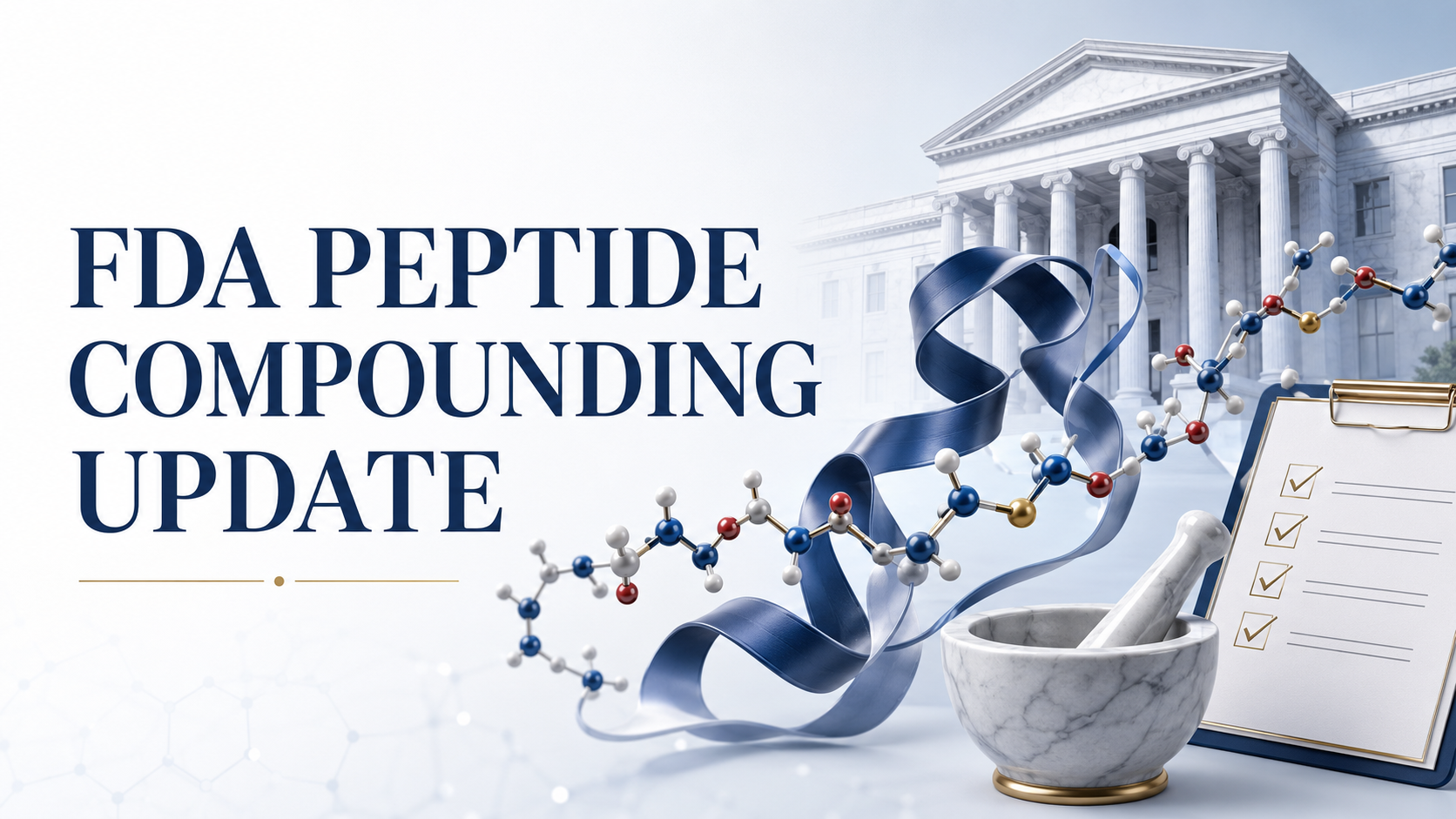
Summary: In July 2026, an FDA advisory committee recommended that six peptide families—BPC-157, KPV, TB-500, MOTS-c, Epitalon, and Semax—be considered for inclusion on the federal list of bulk drug substances that may be used in traditional pharmacy compounding. The recommendation was historic, but it did not approve these peptides, immediately legalize them, or authorize pharmacies to begin dispensing them.
That one distinction explains most of the confusion surrounding the meeting.
This guide walks through the entire story in plain English: what peptides are, why pharmacies compounded some of them in the past, what changed in 2023, what “Category 2” means, why FDA removed 12 peptides from that category in 2026, what the Pharmacy Compounding Advisory Committee voted to recommend on July 23–24, what must happen next, and which five substances FDA expects to review at another meeting before the end of February 2027.
Current regulatory status: The July 2026 PCAC votes were nonbinding recommendations. Restorative Compounding Pharmacy + Wellness does not currently compound or dispense the peptides discussed in this article. This page will be updated if FDA’s policies or regulations change.
Key takeaways
PCAC advises FDA; it does not approve drugs or independently change federal law.
Six of seven peptide families received favorable recommendations on July 23–24, 2026.
Emideltide, commonly called DSIP, was the only peptide not recommended.
Removing a substance from Category 2 does not place it in Category 1 and does not make it eligible for compounding.
None of the seven peptides became an FDA-approved medication because of the meeting.
FDA has announced another PCAC meeting before the end of February 2027 for LL-37, GHK-Cu, dihexa acetate, Melanotan II, and PEG-MGF.
Until FDA takes further action, patients should not interpret the meeting as permission to buy “research use only” products from the gray market.
What is a peptide?
A peptide is a chain of amino acids. Amino acids are often described as the building blocks of proteins, but shorter amino-acid chains can also act as signaling molecules in the body. Some influence appetite, blood sugar, hormone release, immune signaling, blood-vessel function, pigmentation, or tissue repair.
Peptide medicines are not inherently experimental. Several well-established, FDA-approved medications are peptides or peptide-based drugs. Insulin is the classic example. Other approved peptide medicines include glucagon-like peptide-1 receptor agonists and certain medications used in endocrinology, fertility care, oncology, and rare diseases.
The controversy is not about whether peptides can be legitimate medicines. It is about whether a specific peptide, made from a specific bulk drug substance, has adequate identity, quality, safety, and clinical support to be used in pharmacy compounding.
What is pharmacy compounding?
Pharmacy compounding is the preparation of a medication for an identified patient when a commercially manufactured drug does not appropriately meet that patient’s medical needs. Examples might include changing a dosage strength, removing an allergenic inactive ingredient, or creating a dosage form a patient can use.
Traditional compounding pharmacies generally operate under Section 503A of the Federal Food, Drug, and Cosmetic Act. A 503A pharmacy compounds medication pursuant to a valid patient-specific prescription and must satisfy federal requirements as well as the laws and regulations of every state in which it practices.
A compounded medication is not the same thing as an FDA-approved drug:
Regulatory review: An FDA-approved drug is reviewed by FDA through an approval application; a 503A compounded medication is not individually reviewed or approved by FDA.
How it is made: An FDA-approved drug is manufactured under the approved application and labeling; a compounded medication is prepared for an identified patient pursuant to a prescription.
Evidence standard: An FDA-approved drug has its safety, efficacy, and manufacturing information reviewed before approval; a compounded medication must meet applicable compounding, quality, and legal requirements, but does not undergo premarket drug approval.
Compounding fills an important clinical role, but it is not a shortcut around the drug-approval process. A pharmacy cannot simply select any chemical sold online and turn it into a prescription product.
When may a 503A pharmacy use a bulk drug substance?
FDA explains that a traditional 503A compounder may use a bulk drug substance if the substance:
Complies with an applicable United States Pharmacopeia or National Formulary monograph, when one exists;
Is a component of an FDA-approved drug when no applicable monograph exists; or
Appears on the 503A Bulks List when neither of the first two pathways applies.
The bulk substance must also be accompanied by a valid certificate of analysis and manufactured by an establishment registered with FDA under Section 510. These requirements are particularly important for peptides, which can present challenges involving identity, salt form, purity, aggregation, degradation products, sterility, endotoxins, and immune reactions.
Source: FDA—Bulk Drug Substances Used in Compounding Under Section 503A (https://www.fda.gov/drugs/human-drug-compounding/bulk-drug-substances-used-compounding-under-section-503a-fdc-act)
What are Category 1, Category 2, and Category 3?
FDA created interim categories while it evaluates nominated substances for the 503A Bulks List. These categories are often mistaken for the final statutory list.
Category 1 — Adequately nominated, potentially eligible, and not identified in another category — FDA generally states it does not intend to take action when all conditions in its interim policy are satisfied
Category 2 — Adequately nominated, but FDA identified potential significant safety risks — Not covered by the Category 1 enforcement-discretion policy
Category 3 — Nominated without enough supporting information for FDA to evaluate — Not covered by the Category 1 enforcement-discretion policy
Two cautions matter: First, Category 1 is not the same as FDA approval. It is an interim enforcement-policy category. Second, being removed from Category 2 does not automatically move a substance into Category 1. A substance can be absent from Category 2 and still remain ineligible for 503A compounding.
FDA’s explanation of the categories is available on its 503A bulk drug substances page (https://www.fda.gov/drugs/human-drug-compounding/bulk-drug-substances-used-compounding-under-section-503a-fdc-act).
How were pharmacies compounding peptides before 2023?
Before FDA’s September 2023 action, peptide compounding existed in a legally complicated environment. Peptides were nominated for the 503A and/or 503B bulk-substance pathways, and some pharmacies treated the absence of an explicit Category 2 designation as allowing compounding under enforcement discretion or other interpretations.
That history is frequently summarized online as “peptides used to be legal.” The more accurate version is narrower: the federal status of individual substances depended on the applicable monograph, approved-drug-component status, nomination history, FDA’s interim lists and guidance, the type of compounder, the route and preparation, and state law.
FDA later emphasized that several peptides placed in Category 2 had never been in 503A Category 1. Therefore, a pharmacy’s earlier practice does not itself establish that the substance was legally eligible under Section 503A.
This distinction matters because the current debate is not simply about returning to the way things were. It is about creating a clearer, defensible pathway for specific substances.
What happened in September 2023?
In September 2023, FDA added numerous peptide-related substances to Category 2 based on what it described as potential significant safety risks. FDA’s concerns varied by substance but repeatedly included:
possible immunogenicity, meaning the body could mount an unwanted immune response;
peptide aggregation and degradation;
peptide-related and manufacturing-process impurities;
difficulty identifying or characterizing the correct active pharmaceutical ingredient;
limited human exposure and clinical safety information;
serious adverse events associated with certain substances or routes;
uncertainty about whether commercial material matched the substance described in research.
The 2023 action sharply reduced the ability of state-licensed 503A pharmacies to prepare affected peptides under FDA’s interim enforcement approach. The action did not eliminate demand. Instead, many patients encountered websites selling vials or capsules labeled “research use only,” “not for human consumption,” or “laboratory use.” Those products may be purchased without a valid prescription and without the pharmacist, prescriber, patient-specific formulation, sourcing review, potency verification, sterility assurance, counseling, and adverse-event process expected in legitimate medication use.
FDA’s current Category 2 safety page remains available at Certain Bulk Drug Substances for Use in Compounding That May Present Significant Safety Risks (https://www.fda.gov/drugs/human-drug-compounding/certain-bulk-drug-substances-use-compounding-may-present-significant-safety-risks).
Why did the 2023 Category 2 decision become controversial?
The decision produced three overlapping concerns.
1. Process and transparency
Industry stakeholders questioned how FDA placed substances into Category 2, how nominations were evaluated, and whether affected parties received an adequate opportunity to respond. Litigation involving AOD-9604, CJC-1295, ipamorelin acetate, and thymosin alpha-1 challenged aspects of the process.
2. Evidence and uncertainty
FDA emphasized limited controlled human evidence and chemistry concerns. Supporters of regulated access argued that limited evidence should be weighed against historical use, clinician experience, patient demand, and the dangers of pushing consumers toward unregulated suppliers.
3. The gray-market problem
Restricting licensed pharmacies did not make internet peptide sellers disappear. It may have increased the gap between demand and lawful, professionally supervised access. That does not prove the substances are safe or effective, but it explains why many policymakers, clinicians, pharmacists, and patients have called for a more transparent regulatory pathway.
What changed in April 2026?
On April 15, 2026, FDA announced two connected actions:
seven peptide families would be discussed by PCAC on July 23–24, 2026; and five additional peptide or peptide-derived substances would be considered at another PCAC meeting before the end of February 2027. The 12 substances were removed from the 503A Category 2 grouping so FDA could continue evaluating them:
Reviewed in July 2026:
BPC-157
KPV
TB-500, identified by FDA as thymosin beta-4 fragment LKKTETQ
MOTS-c
Emideltide, also called DSIP
Epitalon
Semax
Expected to be reviewed before the end of February 2027:
Cathelicidin LL-37
GHK-Cu
Dihexa acetate
Melanotan II
Pegylated mechano growth factor (PEG-MGF)
Removal from Category 2 was a procedural change, not authorization to compound. FDA’s own process still had to evaluate each substance for possible inclusion on the 503A Bulks List.
What is PCAC?
PCAC is the Pharmacy Compounding Advisory Committee. It is an expert advisory committee that provides recommendations to FDA about scientific, technical, and medical questions involving pharmacy compounding.
PCAC may review:
how well a bulk drug substance is chemically characterized;
whether it has a history of use in compounding;
evidence of effectiveness or lack of effectiveness;
known and potential safety concerns;
the clinical need for a compounded preparation;
whether FDA-approved alternatives exist;
manufacturing, impurity, stability, and quality issues.
PCAC does not approve drugs. FDA states that advisory committee recommendations are nonbinding, although the agency often considers them closely.
Source: FDA July 23–24, 2026 PCAC meeting page (https://www.fda.gov/advisory-committees/advisory-committee-calendar/july-23-24-2026-meeting-pharmacy-compounding-advisory-committee-07232026)
Which uses did FDA evaluate?
FDA did not attempt to validate every benefit claimed for these peptides on social media or in wellness clinics. It evaluated specific uses supported in the nomination and meeting record:
BPC-157 — Ulcerative colitis
KPV — Wound healing and inflammatory conditions
TB-500 — Wound healing
MOTS-c — Obesity and osteoporosis
Emideltide/DSIP — Opioid withdrawal, chronic insomnia, and narcolepsy
Semax — Cerebral ischemia, migraine, and trigeminal neuralgia
Epitalon — Insomnia
Inclusion on the 503A Bulks List, if ultimately finalized, is generally not an FDA approval of those uses. Nor does a vote establish that the peptide works for broader marketed purposes such as injury recovery, muscle gain, anti-aging, cognition, or longevity.
What did FDA staff conclude before the vote?
FDA’s multidisciplinary briefing documents examined chemistry, historical use, effectiveness, and safety. Agency reviewers generally recommended against placing the peptide substances on the 503A Bulks List, citing issues such as:
inconsistent terminology for free-base and acetate forms;
uncertain or inadequate reference standards;
incomplete certificates of analysis;
limited validated analytical methods;
potential peptide impurities and aggregation;
insufficient stability data;
limited high-quality human evidence;
unclear benefit-risk profiles.
These concerns should not be erased from the story merely because the committee voted differently. A trustworthy explanation must present both the favorable committee recommendation and the limitations identified by FDA’s scientific staff. FDA published a separate briefing document for each family:
BPC-157 FDA briefing document (https://www.fda.gov/media/193343/download)
Emideltide/DSIP FDA briefing document (https://www.fda.gov/media/193344/download)
Epitalon FDA briefing document (https://www.fda.gov/media/193345/download)
KPV FDA briefing document (https://www.fda.gov/media/193346/download)
MOTS-c FDA briefing document (https://www.fda.gov/media/193347/download)
Semax FDA briefing document (https://www.fda.gov/media/193348/download)
TB-500 FDA briefing document (https://www.fda.gov/media/193349/download)
What happened at the July 23–24, 2026 meeting?
PCAC considered the free-base and acetate forms of the seven peptide families. Over two days, the committee recommended six families for inclusion on the 503A Bulks List:
BPC-157 — Favorable recommendation
KPV — Favorable recommendation
TB-500 — Favorable recommendation
MOTS-c — Favorable recommendation
Epitalon — Favorable recommendation
Semax — Favorable recommendation
Emideltide/DSIP — Not recommended
Reported topline votes included an 8–6 favorable vote for BPC-157, a 7–4 favorable vote for Epitalon, an 8–5 favorable vote for Semax, and a 6–7 vote against Emideltide, with abstentions reported in those deliberations. Because FDA considered distinct free-base and acetate bulk substances and the official record may be updated, readers should consult the final meeting minutes for the definitive substance-by-substance vote table when FDA posts it.
The central result is unchanged: six of the seven peptide families received favorable advisory recommendations, and DSIP did not.
Does the PCAC vote mean these peptides are FDA approved?
No. “FDA approved” means FDA reviewed and approved a drug application for a specific product, manufacturer, formulation, indication, dose, labeling, and manufacturing process. PCAC’s vote did none of those things.
The vote also did not:
establish the safety or effectiveness of any internet peptide product;
approve every proposed use;
verify every supplier’s raw material;
authorize sale without a prescription;
eliminate state-law requirements;
permit a pharmacy to begin compounding immediately;
convert a compounded medication into an FDA-approved drug.
Are the six favorably recommended peptides legal to compound now?
Not solely because of the vote. As of this review, FDA has not placed these six peptide families on the final 503A Bulks List or publicly announced an applicable interim enforcement policy authorizing compounding. A state-licensed 503A pharmacy must still satisfy the bulk-substance requirements of Section 503A and all applicable federal and state requirements.
PCAC recommended six peptide families for possible inclusion on the 503A Bulks List. Final FDA action remains pending.
What happens next?
Several paths are possible:
FDA accepts the recommendations and begins or completes rulemaking. The agency could propose adding some or all favorably recommended substances to the 503A Bulks List, receive public comments, and issue a final rule.
FDA announces an interim enforcement approach. FDA could clarify whether certain substances fall within an interim policy while rulemaking proceeds.
FDA requests additional information. Chemistry, analytical standards, sourcing, dosing, stability, or safety questions may delay action.
FDA disagrees with PCAC. The recommendations are nonbinding.
FDA distinguishes among forms. A free base and an acetate are distinct bulk drug substances. FDA could treat them differently.
There is no guaranteed timeline. Interested patients and providers should watch FDA’s compounding pages rather than relying on social-media announcements or seller emails.
What is scheduled before February 2027?
FDA states that PCAC will meet again before the end of February 2027. An exact date and time had not been posted as of July 26, 2026. The announced agenda includes:
Cathelicidin LL-37
LL-37 is an antimicrobial peptide involved in innate immune defense. It has been studied in laboratory and animal models involving antimicrobial activity, immune signaling, wound repair, and biofilms. FDA previously identified concerns including limited human safety information, possible immunogenicity, reproductive findings in nonclinical research, and the possibility of tumor-promoting activity in certain tissues.
GHK-Cu
GHK-Cu is a copper-binding tripeptide commonly discussed in dermatology, skin appearance, collagen biology, wound healing, and hair research. Topical cosmetic use and injectable drug use are not interchangeable. FDA’s announced PCAC review concerns GHK-Cu as a bulk drug substance; route-specific evidence and safety will be important.
Dihexa acetate
Dihexa is an experimental peptide-derived compound discussed for cognition and neuroregeneration. FDA previously stated that it had not identified human exposure data for drug products containing dihexa acetate. Claims involving memory or neurodegenerative disease therefore require extreme caution.
Melanotan II
Melanotan II is a synthetic melanocortin analog promoted for tanning and sometimes sexual effects. FDA has cited case reports involving serious adverse events, including priapism, sympathomimetic toxicity, posterior reversible encephalopathy syndrome, and melanoma reports. Association does not always prove causation, but the safety signals explain why rigorous review is needed.
PEG-MGF
Pegylated mechano growth factor is promoted for muscle repair and growth. FDA has stated that it has not identified human exposure data for PEG-MGF drug products and has raised questions about immunogenicity, impurities, and characterization.
The official agenda is available on FDA’s upcoming PCAC meeting page (https://www.fda.gov/advisory-committees/pharmacy-compounding-advisory-committee/meeting-pharmacy-compounding-advisory-committee).
Why regulated prescription access matters?
The demand for peptides is real. Pretending otherwise does not protect patients. The better long-term goal is a transparent pathway in which any peptide that becomes legally eligible for compounding is:
prescribed for an identified patient by a licensed clinician;
dispensed by a properly licensed pharmacy;
sourced from an appropriately registered and qualified manufacturer;
accompanied by a valid certificate of analysis;
verified for identity, potency, purity, and relevant impurities;
compounded using validated processes;
tested appropriately for the dosage form, including sterility and endotoxins when required;
labeled and stored correctly;
supported by pharmacist counseling and adverse-event reporting;
offered without exaggerating uncertain benefits.
That is fundamentally different from buying a vial labeled “research use only” from an anonymous website. Regulated access, however, cannot mean lowering scientific or quality standards. It means creating a lawful channel where the substance, prescription, preparation, patient, and clinical decision are identifiable and accountable.
Why peptide quality is more complicated than a “99% purity” claim?
A seller’s statement that a product is “99% pure” does not answer all relevant questions. A complete quality assessment may need to establish:
the exact amino-acid sequence;
whether the material is the free base, acetate, or another salt;
peptide content versus total vial weight;
water and residual solvent content;
synthesis-related impurities;
deletion, insertion, racemization, or truncated peptide sequences;
aggregates and degradation products;
bioburden;
bacterial endotoxins;
sterility for sterile preparations;
stability after reconstitution;
container-closure compatibility;
potency throughout the assigned beyond-use date.
This is why a trusted prescription pathway must involve more than transferring powder into a vial.
What should patients do right now?
Do not interpret a favorable committee vote as FDA approval.
Avoid products marketed only as “research use only” for self-injection or self-treatment.
Do not use a peptide because an influencer presented animal research as a proven human benefit.
Ask whether a proposed product is FDA approved, lawfully compounded, or neither.
Discuss the strength of the evidence, alternatives, potential harms, interactions, and monitoring with a qualified clinician.
If you compete in tested sport, check the current World Anti-Doping Agency rules. BPC-157 is prohibited under WADA’s non-approved-substances category, and other substances may also create anti-doping risk.
Follow FDA updates and state-board requirements.
Restorative Compounding Pharmacy’s position
Restorative Compounding Pharmacy + Wellness supports a careful pathway that protects patients while recognizing legitimate clinical demand. Our goal is to become a trusted source of accurate peptide education and, if federal and state requirements ultimately permit, appropriately prescribed compounded preparations made from qualified ingredients under rigorous pharmacy standards.
We do not believe patients should have to choose between exaggerated internet claims and no understandable information at all. We also do not believe popularity can substitute for evidence. If lawful access becomes available, our priorities will remain:
patient-specific prescriptions;
qualified sourcing;
identity and quality verification;
appropriate formulation and testing;
transparent counseling;
responsible pricing;
collaboration with licensed prescribers;
honest communication about what research does and does not show.
Frequently asked questions
Did FDA approve BPC-157 in July 2026?
No. PCAC recommended BPC-157-related bulk drug substances for possible inclusion on the 503A Bulks List. That is not FDA drug approval and did not immediately authorize compounding.
What is the difference between PCAC and FDA?
PCAC is an advisory committee. It reviews information and makes recommendations. FDA is the federal agency that makes the ultimate regulatory decision.
What does Category 2 mean?
Category 2 is an interim FDA designation for nominated bulk drug substances for which FDA identified potential significant safety risks. Substances in Category 2 are outside FDA’s Category 1 enforcement-discretion policy.
Were the peptides moved from Category 2 to Category 1?
No. FDA removed 12 substances from the 503A Category 2 grouping for further evaluation. Removal did not automatically place them in Category 1.
Which peptide did PCAC reject?
Emideltide, commonly called delta sleep-inducing peptide or DSIP, did not receive a favorable recommendation.
Which peptides are planned for the next meeting?
FDA plans to review LL-37, GHK-Cu, dihexa acetate, Melanotan II, and PEG-MGF at a meeting before the end of February 2027.
Can patients buy these peptides without a prescription?
A favorable PCAC recommendation does not authorize nonprescription sale. Products sold online as research chemicals are not converted into legitimate medications by the committee vote.
Are compounded medications FDA approved?
No. Compounded drugs are not FDA approved. They may be prepared when legal requirements are satisfied and a patient has a valid prescription, but they do not undergo FDA premarket approval.
When will the six peptides become available?
There is no confirmed date. Availability would require further FDA action, compliance with state law, qualified sourcing, appropriate testing, validated formulations, and a patient-specific prescription.
References
FDA. July 23–24, 2026 Meeting of the Pharmacy Compounding Advisory Committee (https://www.fda.gov/advisory-committees/advisory-committee-calendar/july-23-24-2026-meeting-pharmacy-compounding-advisory-committee-07232026).
FDA. Bulk Drug Substances Used in Compounding Under Section 503A (https://www.fda.gov/drugs/human-drug-compounding/bulk-drug-substances-used-compounding-under-section-503a-fdc-act).
FDA. Certain Bulk Drug Substances for Use in Compounding That May Present Significant Safety Risks (https://www.fda.gov/drugs/human-drug-compounding/certain-bulk-drug-substances-use-compounding-may-present-significant-safety-risks).
FDA. Upcoming Meeting of the Pharmacy Compounding Advisory Committee (https://www.fda.gov/advisory-committees/pharmacy-compounding-advisory-committee/meeting-pharmacy-compounding-advisory-committee).
FDA. BPC-157 briefing document (https://www.fda.gov/media/193343/download).
FDA. Emideltide briefing document (https://www.fda.gov/media/193344/download).
FDA. Epitalon briefing document (https://www.fda.gov/media/193345/download).
FDA. KPV briefing document (https://www.fda.gov/media/193346/download).
FDA. MOTS-c briefing document (https://www.fda.gov/media/193347/download).
FDA. Semax briefing document (https://www.fda.gov/media/193348/download).
FDA. TB-500 briefing document (https://www.fda.gov/media/193349/download).
This article is for educational purposes and is not medical advice. Compounded medications are not FDA approved. Regulatory status can change, and applicable requirements may differ by jurisdiction.