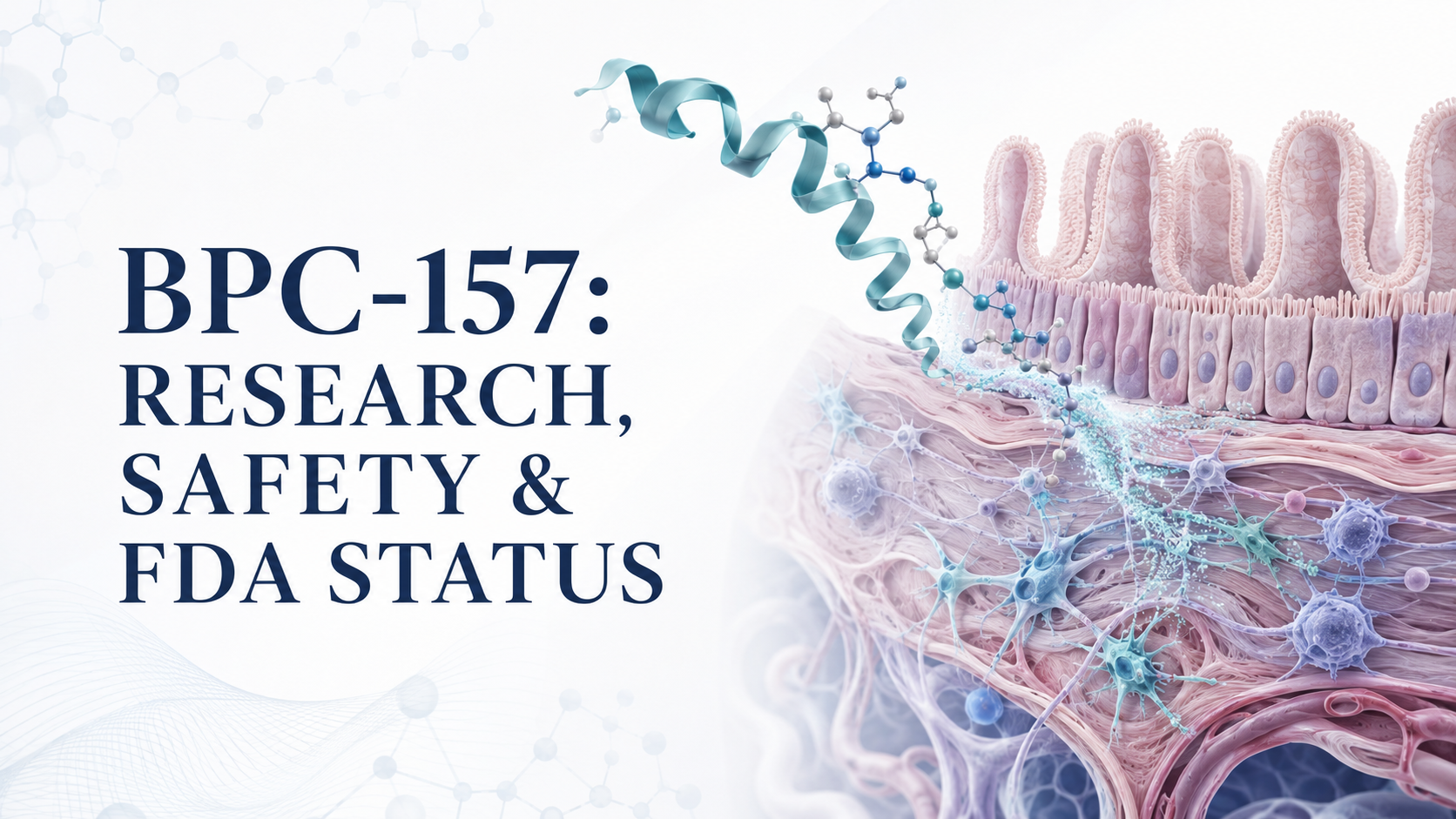
Summary: BPC-157 is a synthetic 15-amino-acid peptide promoted for tendon, ligament, muscle, bone, wound, and gastrointestinal recovery. Its online popularity is far ahead of its human clinical evidence. In July 2026, PCAC recommended BPC-157-related bulk drug substances for possible inclusion on the 503A Bulks List, but BPC-157 remains unapproved by FDA and the vote did not immediately authorize pharmacy compounding. Restorative Compounding Pharmacy + Wellness does not currently compound or dispense BPC-157. PCAC’s July 2026 recommendation was advisory, not FDA approval or immediate authorization to compound.
Key takeaways
BPC-157 is a laboratory-made pentadecapeptide, not an FDA-approved drug.
Most reported healing benefits come from cell and animal studies.
FDA formally evaluated BPC-157 for ulcerative colitis, not every use promoted online.
FDA identified major questions involving chemical identity, acetate versus free-base material, impurities, stability, safety, and limited human evidence.
PCAC nevertheless issued a favorable recommendation in July 2026.
BPC-157 is prohibited for athletes under the World Anti-Doping Agency’s rules for non-approved substances.
What is BPC-157?
BPC-157 is a 15-amino-acid peptide with the sequence Gly-Glu-Pro-Pro-Pro-Gly-Lys-Pro-Ala-Asp-Asp-Ala-Gly-Leu-Val. It is often expanded as “Body Protection Compound 157” and has also been called Bepecin or PL-14736.
Marketing frequently describes BPC-157 as a naturally occurring gastric peptide. A more precise explanation is that BPC-157 is a synthetic peptide sequence associated with research on a protective compound described in gastric juice. The isolated drug substance sold as BPC-157 is not an FDA-approved natural supplement.
FDA treated BPC-157 free base and BPC-157 acetate as different bulk drug substances. This is not a trivial labeling difference: salt form can affect identification, molecular weight, solubility, stability, testing, formulation, and dosing calculations.
How is BPC-157 proposed to work?
Preclinical research has explored several overlapping pathways:
modulation of nitric-oxide signaling;
angiogenesis, or formation of new blood vessels;
fibroblast migration and tissue organization;
inflammatory signaling;
preservation of gastrointestinal mucosa;
interactions with growth-factor pathways;
effects on tendon-to-bone and soft-tissue repair.
These mechanisms are hypotheses supported mainly by laboratory and animal data. A plausible mechanism does not prove a meaningful clinical benefit in people.
What benefits is BPC-157 commonly promoted for?
Across wellness, sports-recovery, and regenerative-medicine settings, BPC-157 is discussed for:
tendon and ligament injuries;
muscle strains and recovery;
joint discomfort;
bone healing;
postsurgical recovery;
skin wounds;
inflammatory bowel disease;
ulcers and NSAID-related gastrointestinal injury;
“gut healing” or intestinal barrier support;
nerve injury;
systemic inflammation.
These are marketed or investigated uses—not a list of FDA-approved indications.
What does the research show?
Tendon, ligament, muscle, and bone research
Animal models have reported changes in tendon healing, muscle injury, ligament repair, and bone-related outcomes. These studies help generate hypotheses but cannot establish the dose, benefit, long-term safety, or appropriate patient population in humans.
Gastrointestinal research
BPC-157 has been studied in animal models of gastrointestinal injury, inflammatory conditions, fistulas, ulcers, and medication-associated mucosal damage. Because of this history, FDA evaluated the nominated bulk substances specifically for ulcerative colitis.
FDA reported that nominations also referenced Crohn’s disease, celiac disease, and tendonitis, but the agency did not evaluate those uses because the nomination lacked sufficient information and FDA did not identify relevant clinical studies.
Human evidence
Human evidence is extremely limited compared with the volume of online claims. A small early clinical development program was registered, but BPC-157 has not been established as safe and effective through the type of replicated, randomized, adequately powered human trials expected for drug approval.
A recent narrative review summarizes the broad preclinical literature while acknowledging the evidence gap: Józwiak M, et al. Multifunctionality and Possible Medical Application of BPC-157 (https://pmc.ncbi.nlm.nih.gov/articles/PMC11859134/). Reviews are useful maps of the literature, but they do not substitute for controlled trials.
What did FDA find?
FDA’s 2026 briefing document identified several concerns:
inconsistent nomination information about whether the substance was BPC-157 free base or acetate;
certificates of analysis that did not consistently match the named substance;
lack of a USP/NF monograph;
no FDA-approved drug containing BPC-157;
limited clinical evidence;
potential aggregation, degradation, and immune reactions;
uncertainty about impurities and validated analytical testing;
dosage-form-specific quality concerns for injections, capsules, nasal sprays, creams, and suppositories.
FDA staff concluded that the criteria weighed against listing both the free base and acetate. PCAC reached a different advisory conclusion and voted favorably.
Read the full FDA BPC-157 briefing document (https://www.fda.gov/media/193343/download).
What did PCAC decide?
On July 23, 2026, PCAC recommended BPC-157-related bulk drug substances for inclusion on the 503A Bulks List. The topline vote was reported as 8–6, with an abstention.
That recommendation means the committee believed FDA should consider allowing the substances within the 503A bulk-drug framework. It does not mean:
BPC-157 is FDA approved;
FDA agreed with the committee;
the product is proven for injury recovery or gut health;
every “BPC-157” raw material is chemically equivalent;
pharmacies may immediately compound it;
nonprescription research-chemical sales are legitimate.
What are the potential safety concerns?
The absence of extensive human safety data is itself important. Questions include:
immune reactions to the peptide or aggregates;
impurities generated during synthesis;
degradation during storage or after reconstitution;
contamination, endotoxins, or loss of sterility in injectable products;
inconsistent identity or concentration;
unknown long-term effects;
uncertain interactions with cancer biology, angiogenesis, wound healing, or other medications;
risk of delaying established treatment.
Animal findings should not be assumed to predict human safety.
Is BPC-157 permitted in competitive sport?
BPC-157 is prohibited under the World Anti-Doping Agency’s S0 category for non-approved substances. Athletes subject to anti-doping rules should not assume a prescription, future compounding status, or a product’s “research” label makes its use permissible.
See the current WADA Prohibited List (https://www.wada-ama.org/en/prohibited-list).
Why the gray market is risky
Websites may advertise “99% pure” BPC-157 while disclaiming that it is not for human use. That number alone does not establish:
correct sequence and salt form;
peptide content;
identity of the remaining material;
sterility or endotoxin compliance;
absence of synthesis byproducts;
stability after shipping or reconstitution;
an appropriate dose or route;
lawful dispensing.
If BPC-157 becomes eligible for compounding, the safer model would involve a licensed prescriber, identified patient, qualified pharmacy, registered bulk manufacturer, valid certificate of analysis, appropriate testing, validated formulation, counseling, and follow-up.
Frequently asked questions
Is BPC-157 FDA approved?
No. BPC-157 is not an FDA-approved drug.
Did the FDA legalize BPC-157 in July 2026?
No. An FDA advisory committee recommended possible inclusion on the 503A Bulks List. Final FDA action is pending.
Does BPC-157 heal tendons?
Animal studies are encouraging, but adequate controlled human trials have not established that BPC-157 safely improves tendon healing.
References
FDA. BPC-157-Related Bulk Drug Substances Briefing Document (https://www.fda.gov/media/193343/download).
FDA. July 23–24, 2026 PCAC Meeting (https://www.fda.gov/advisory-committees/advisory-committee-calendar/july-23-24-2026-meeting-pharmacy-compounding-advisory-committee-07232026).
Józwiak M, et al. Multifunctionality and Possible Medical Application of BPC-157 (https://pmc.ncbi.nlm.nih.gov/articles/PMC11859134/).
U.S. Operation Supplement Safety. BPC-157: A Prohibited Peptide and an Unapproved Drug (https://www.opss.org/article/bpc-157-prohibited-peptide-and-unapproved-drug-found-health-and-wellness-products).
WADA. The Prohibited List (https://www.wada-ama.org/en/prohibited-list).
This article is educational and is not individualized medical advice. Compounded drugs are not FDA approved.