Semax Peptide: Neurological, Cognitive, Stroke and Migraine Research and FDA Status
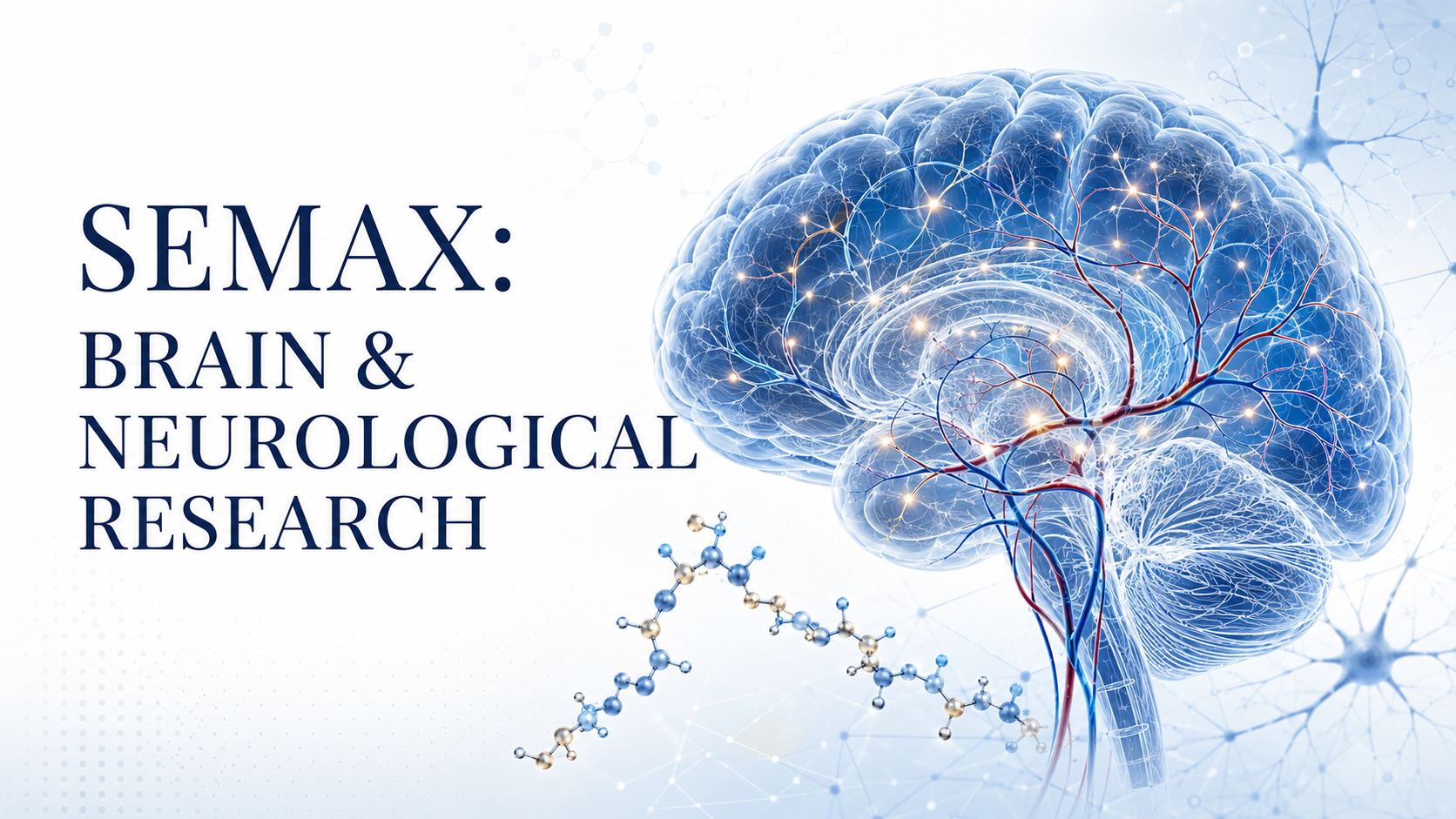
Summary: Semax is a synthetic seven-amino-acid peptide derived from an adrenocorticotropic-hormone fragment and studied mainly for neurological applications. Russian studies have examined intranasal Semax in ischemic stroke and other conditions, while U.S.-standard evidence remains limited. PCAC recommended Semax-related bulk substances for possible 503A listing in July 2026; Semax remains unapproved by FDA and is not immediately authorized for compounding. Restorative Compounding Pharmacy + Wellness does not currently compound or dispense Semax. PCAC’s recommendation was advisory.
Key takeaways
Semax is the heptapeptide Met-Glu-His-Phe-Pro-Gly-Pro.
It was designed from the ACTH(4–7) sequence with a Pro-Gly-Pro extension.
It is promoted for cognition, focus, anxiety, brain injury, stroke recovery, migraine, and neuroprotection.
FDA evaluated cerebral ischemia, migraine, and trigeminal neuralgia.
Some human stroke studies exist, but the overall evidence has limitations and is not equivalent to FDA approval.
PCAC issued a favorable recommendation in July 2026.
What is Semax?
Semax is a synthetic analog based on a fragment of adrenocorticotropic hormone, or ACTH. Its sequence is Met-Glu-His-Phe-Pro-Gly-Pro. It was designed to retain neurological activity without the full hormone’s adrenal effects.
Semax has been used or authorized in certain countries, particularly Russia, but foreign marketing authorization is not FDA approval. Differences in product composition, indications, clinical-trial standards, manufacturing, and pharmacovigilance must be considered. FDA evaluated Semax free base and Semax acetate separately.
How might Semax work?
Research has explored:
brain-derived neurotrophic factor signaling;
nerve growth factor pathways;
inflammatory and oxidative responses;
cerebral blood-flow and ischemic-injury pathways;
gene expression after brain injury;
neurotransmitter systems;
modulation of the melanocortin system;
the activity of its Pro-Gly-Pro fragment.
Many mechanistic findings come from rodent models of focal cerebral ischemia.
What is Semax commonly promoted for?
attention, focus, and memory;
cognitive enhancement or “nootropic” effects;
anxiety and stress resilience;
ischemic stroke recovery;
traumatic brain injury;
migraine;
trigeminal neuralgia;
optic-nerve and retinal conditions;
ADHD;
neurodegenerative diseases;
fatigue and mood.
These are not FDA-approved uses.
What does the research show?
Ischemic stroke
Several Russian-language or regional clinical publications have examined Semax in acute ischemic stroke and rehabilitation. A 1997 report described Semax in 30 patients with acute hemispheric ischemic stroke: Gusev EI, et al. Effectiveness of Semax in Acute Hemispheric Ischemic Stroke (https://pubmed.ncbi.nlm.nih.gov/11517472/). A later study reported associations with BDNF levels and recovery measures during rehabilitation: Gusev EI, et al. Efficacy of Semax in Patients at Different Stages of Ischemic Stroke (https://pubmed.ncbi.nlm.nih.gov/29798983/). These studies create a human evidence signal, but questions remain about design, sample size, blinding, background therapy, translation, replication, clinical endpoints, and applicability to U.S. formulations.
Migraine and trigeminal neuralgia
These uses were part of FDA’s evaluation, but the agency found the evidence insufficient to establish effectiveness. Claims online may extrapolate from neuropeptide mechanisms rather than controlled clinical outcomes.
Cognition and “nootropic” use
Semax is widely promoted for focus and memory, but those claims were not the central basis of FDA’s PCAC review. Healthy-person cognitive enhancement has not been established through large, replicated, high-quality trials.
What did FDA find?
FDA evaluated:
identity and characterization of Semax free base and acetate;
available synthesis and impurity information;
stability and dosage-form concerns;
history of use in compounding;
foreign and published clinical information;
evidence for cerebral ischemia, migraine, and trigeminal neuralgia;
safety, immunogenicity, and route-specific risks.
FDA staff concluded that the evaluation criteria weighed against inclusion. PCAC voted favorably. Read the FDA Semax briefing document (https://www.fda.gov/media/193348/download).
What did PCAC decide?
On July 24, 2026, PCAC recommended Semax-related bulk drug substances for inclusion on the 503A Bulks List. The vote was reported as 8–5, with an abstention.
The vote did not:
approve Semax for stroke, migraine, pain, or cognition;
establish equivalence to a foreign product;
authorize immediate compounding;
validate every nasal-spray formulation;
establish a safe self-directed “nootropic” dose.
Why nasal peptide products require special attention
Intranasal products are not simply liquid placed in a spray bottle. Quality considerations include:
concentration and content uniformity;
pump-delivery accuracy;
spray pattern and plume;
droplet-size distribution;
microbial quality;
preservative effectiveness when applicable;
pH, tonicity, and tolerability;
container compatibility;
adsorption of peptide to the device;
stability after opening.
An online seller’s milligram claim does not establish delivered dose per spray.
Potential risks and unknowns
limited U.S.-standard safety evidence;
immune reactions and peptide impurities;
variable intranasal absorption;
nasal irritation or infection risk;
unknown psychiatric, neurological, cardiovascular, and endocrine effects;
unknown interactions with neurological medications;
risk of delaying emergency stroke treatment;
lack of long-term cognitive-enhancement safety data;
formulation and pump inconsistency.
Suspected stroke is a medical emergency. No peptide should delay emergency evaluation or evidence-based reperfusion therapy.
Frequently asked questions
Is Semax FDA approved?
No. It is not an FDA-approved drug in the United States.
Is Semax approved in Russia?
Semax has a history of medical use in Russia, but foreign authorization does not establish FDA approval or eligibility for U.S. compounding.
Does Semax improve memory or focus?
Mechanistic and limited clinical research is of interest, but robust evidence in healthy people is insufficient to establish a safe and effective cognitive-enhancement treatment.
Can Semax be compounded after the vote?
Not based on the advisory vote alone. Further FDA action is required.
References
FDA. Semax-Related Bulk Drug Substances Briefing Document (https://www.fda.gov/media/193348/download).
Gusev EI, et al. Effectiveness of Semax in Acute Hemispheric Ischemic Stroke (https://pubmed.ncbi.nlm.nih.gov/11517472/).
Gusev EI, et al. Efficacy of Semax During Ischemic Stroke Rehabilitation (https://pubmed.ncbi.nlm.nih.gov/29798983/).
Dmitrieva VG, et al. Semax and Pro-Gly-Pro Activate Neurotrophin and Receptor Gene Transcription After Cerebral Ischemia (https://pubmed.ncbi.nlm.nih.gov/19633950/).
FDA. July 2026 PCAC Meeting (https://www.fda.gov/advisory-committees/advisory-committee-calendar/july-23-24-2026-meeting-pharmacy-compounding-advisory-committee-07232026).