KPV Peptide: Inflammation, Gut and Skin Research, Safety, and FDA Compounding Status
Summary: KPV is the three-amino-acid peptide Lys-Pro-Val, derived from the C-terminal sequence of alpha-melanocyte-stimulating hormone. Researchers have investigated its anti-inflammatory and tissue-repair effects, but FDA reported that it had not identified human exposure data for KPV drug products. PCAC recommended KPV-related bulk substances for possible 503A listing in July 2026; final FDA action remains pending. Restorative Compounding Pharmacy + Wellness does not currently compound or dispense KPV. The favorable PCAC recommendation did not approve KPV or immediately authorize compounding.
Key takeaways
KPV is a tripeptide related to alpha-MSH biology.
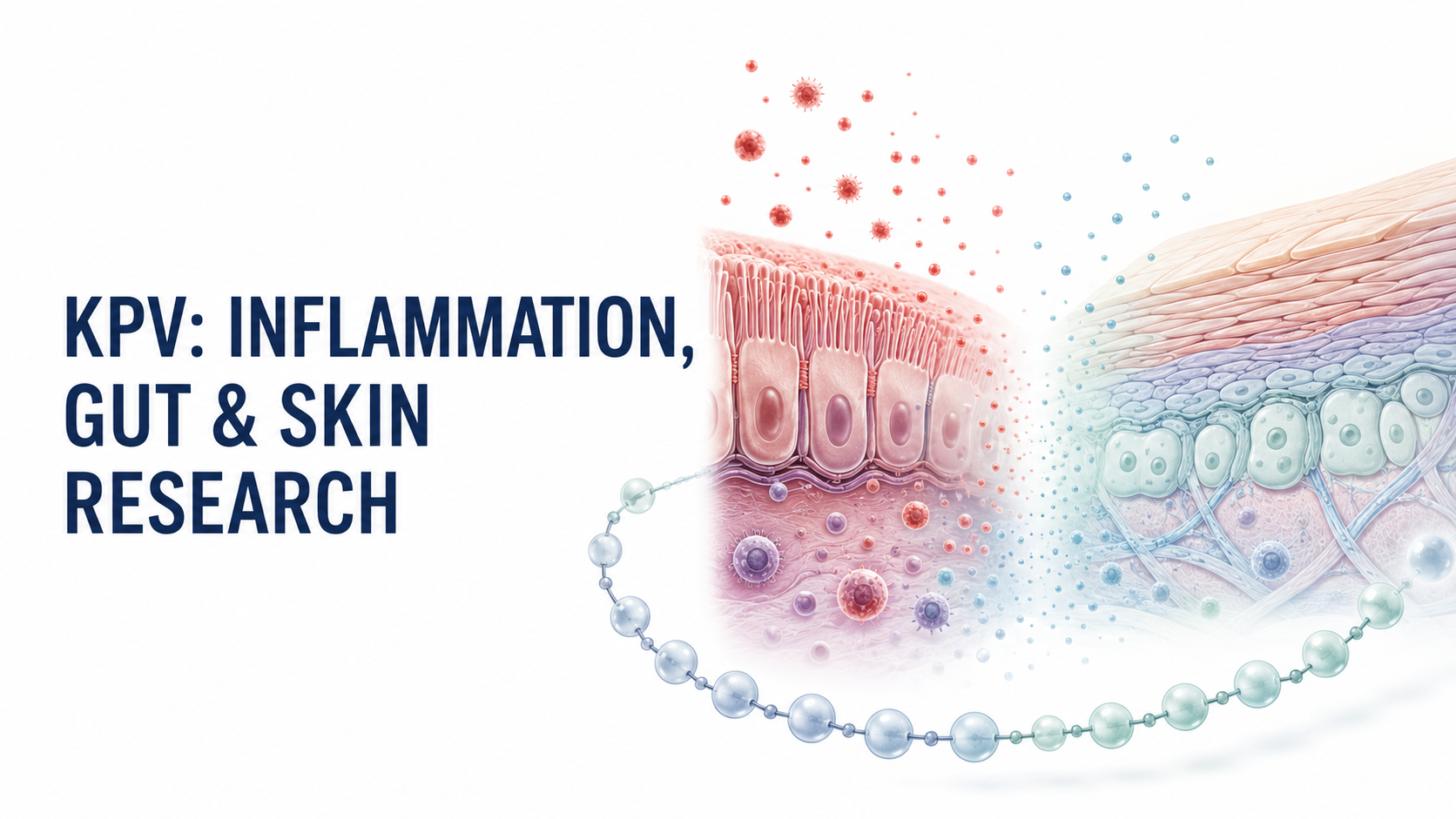
It is studied for inflammatory signaling, gastrointestinal inflammation, skin conditions, infection-related inflammation, and wound repair.
Published evidence is predominantly cellular, formulation, and animal research.
FDA evaluated KPV for wound healing and inflammatory conditions.
FDA highlighted a lack of identified human exposure data and quality-characterization concerns.
PCAC issued a favorable recommendation in July 2026.
What is KPV?
KPV consists of lysine, proline, and valine. It represents amino acids 11–13 of alpha-melanocyte-stimulating hormone, a melanocortin peptide involved in pigmentation and immune signaling.
KPV is commonly described as retaining anti-inflammatory activity without the pigment-related activity associated with the larger hormone. That is a research concept, not an FDA-approved therapeutic claim.
FDA separately considered KPV free base and KPV acetate. As with other peptides, naming the exact bulk drug substance matters because salt form and composition affect analytical identity and formulation.
How might KPV work?
Laboratory research has explored several mechanisms:
modulation of nuclear factor kappa B and inflammatory gene signaling;
reduction of certain inflammatory cytokines;
interactions with melanocortin-related pathways;
entry into intestinal cells through peptide transport systems;
effects on immune-cell activity;
support of epithelial repair;
antimicrobial or anti-biofilm activity in certain experimental systems.
Mechanistic studies explain why KPV is scientifically interesting. They do not establish clinical effectiveness.
What is KPV commonly promoted or studied for?
KPV is discussed for:
inflammatory bowel disease and intestinal inflammation;
“leaky gut” or barrier-support claims;
psoriasis, eczema, dermatitis, and rosacea;
wound healing;
inflammatory skin lesions;
acne-related inflammation;
infection-associated inflammation and biofilms;
systemic inflammatory symptoms.
None of these is an FDA-approved indication for KPV.
What does the evidence show?
Inflammatory bowel disease models
A 2008 study reported that KPV improved outcomes in a mouse transfer-colitis model and reduced inflammatory changes: Kannengiesser K, et al. Melanocortin-Derived Tripeptide KPV Has Anti-Inflammatory Potential in Murine Models of Inflammatory Bowel Disease (https://pubmed.ncbi.nlm.nih.gov/18092346/).
Later delivery-system research has used nanoparticles and other carriers to improve local intestinal delivery. A 2017 animal study reported that hyaluronic-acid-functionalized KPV nanoparticles reduced inflammation and supported mucosal healing in an experimental ulcerative-colitis model: Xiao B, et al. Orally Targeted Delivery of Tripeptide KPV (https://pubmed.ncbi.nlm.nih.gov/28143741/).
These were not large controlled clinical trials in patients.
Wound and skin research
KPV has been incorporated into hydrogels and other experimental materials for wound healing, inflammation, and antimicrobial effects. These formulation studies may eventually inform therapy, but the carrier, route, concentration, wound type, and model can determine the result.
Human evidence
FDA’s 2026 evaluation stated that the agency had not identified human exposure data on drug products containing KPV administered by any route. That does not prove KPV is ineffective; it means basic questions about human dose, absorption, clinical benefit, adverse effects, and long-term risk remain unanswered.
What did FDA evaluate?
FDA evaluated KPV free base and KPV acetate for wound healing and inflammatory conditions. The agency focused on:
whether the substances were adequately characterized;
whether certificates of analysis matched the nominated material;
likely synthesis-related impurities;
aggregation and degradation risks;
available history of use in compounding;
nonclinical evidence;
lack of human clinical evidence;
potential immunogenicity and route-specific risk.
FDA staff recommended against inclusion. PCAC subsequently made a favorable advisory recommendation. Read the FDA KPV briefing document (https://www.fda.gov/media/193346/download).
What did the July 2026 vote mean?
PCAC recommended that KPV-related bulk substances be included on the 503A Bulks List. The vote is a meaningful regulatory milestone, but it does not establish:
FDA approval;
proven benefit for inflammatory disease;
permission to sell KPV without a prescription;
immediate authority for pharmacies to compound;
equivalence of products sold online;
safety for injection, oral use, nasal use, or topical use.
What are the possible safety and quality concerns?
Potential concerns include:
immune responses to the peptide, aggregates, or impurities;
inadequate characterization of free-base versus acetate material;
contamination, endotoxins, or sterility failures in injectable products;
variable absorption across oral, topical, and nasal routes;
unknown pregnancy, pediatric, cancer, autoimmune, renal, and hepatic risks;
unknown interactions with immunomodulators;
lack of established human dosing or monitoring;
delayed treatment of inflammatory disease with proven therapies.
“Only three amino acids” does not automatically mean risk-free.
KPV versus BPC-157 and TB-500
These peptides are sometimes grouped as “healing peptides,” but they are chemically and scientifically distinct:
KPV — Main research theme: inflammatory signaling, epithelial repair, and experimental wound materials. Key limitation: FDA identified no human drug-exposure data.
BPC-157 — Main research theme: GI protection and broad tissue-repair models. Key limitation: human clinical evidence is extremely limited.
TB-500 — Main research theme: actin-related cell migration and wound-healing models. Key limitation: TB-500-specific human therapeutic evidence is lacking.
Combining experimental peptides does not solve their individual evidence gaps and may make adverse effects harder to interpret.
Frequently asked questions
What does KPV stand for?
KPV represents the amino acids lysine, proline, and valine.
Is KPV the same as alpha-MSH?
No. KPV is a three-amino-acid fragment derived from the C-terminal region of alpha-MSH.
Does KPV help inflammatory bowel disease?
Animal and laboratory studies are of interest, but controlled human trials have not established KPV as a safe and effective treatment for inflammatory bowel disease.
Is KPV FDA approved?
No.
Can KPV be compounded now?
PCAC’s recommendation alone did not create immediate compounding authority. Final FDA action and all applicable state requirements remain necessary.
References
FDA. KPV-Related Bulk Drug Substances Briefing Document (https://www.fda.gov/media/193346/download).
Kannengiesser K, et al. Melanocortin-Derived Tripeptide KPV Has Anti-Inflammatory Potential in Murine Models of IBD (https://pubmed.ncbi.nlm.nih.gov/18092346/).
Xiao B, et al. Orally Targeted Delivery of Tripeptide KPV via Hyaluronic Acid-Functionalized Nanoparticles (https://pubmed.ncbi.nlm.nih.gov/28143741/).
Land SC. Mechanism of KPV Action and a Role for MC3R Agonists (https://pubmed.ncbi.nlm.nih.gov/22837805/).
FDA. July 2026 PCAC Meeting (https://www.fda.gov/advisory-committees/advisory-committee-calendar/july-23-24-2026-meeting-pharmacy-compounding-advisory-committee-07232026).