Summary: TB-500 is commonly marketed as a recovery peptide, but FDA’s 2026 review concerned a specific seven-amino-acid thymosin beta-4 fragment with the sequence LKKTETQ—not the full 43-amino-acid thymosin beta-4 molecule. Laboratory findings involving full-length thymosin beta-4 cannot automatically be attributed to TB-500. PCAC recommended TB-500-related bulk substances for possible 503A listing, but final FDA action remains pending. Restorative Compounding Pharmacy + Wellness does not currently compound or dispense TB-500. The July 2026 PCAC recommendation was advisory.
Key takeaways
FDA defined TB-500 as the thymosin beta-4 fragment LKKTETQ.
Full-length thymosin beta-4, TB-500, and their metabolites should not be treated as interchangeable.
TB-500 is promoted for muscle, tendon, ligament, wound, and postsurgical recovery.
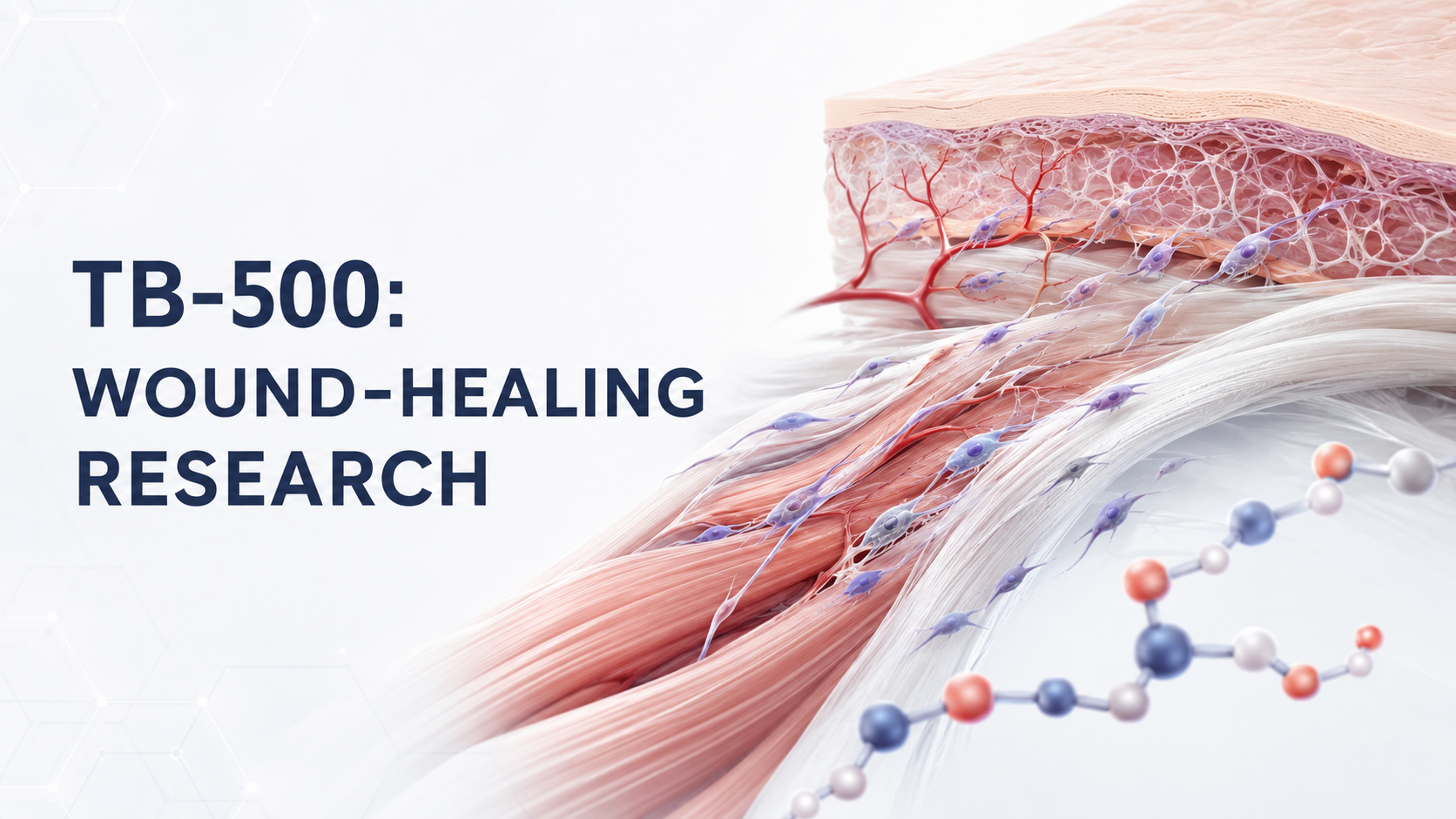
FDA evaluated wound healing.
Direct human therapeutic evidence for TB-500 is lacking.
PCAC issued a favorable recommendation, but TB-500 did not become FDA approved or immediately compoundable.
What is TB-500?
TB-500 is a common name used for a peptide related to thymosin beta-4. FDA’s meeting materials identify the reviewed substance as thymosin beta-4 fragment (LKKTETQ), a seven-amino-acid sequence, in free-base and acetate forms.
That specificity is essential. Online articles often cite research involving:
endogenous full-length thymosin beta-4;
recombinant or synthetic full-length thymosin beta-4;
TB-500/LKKTETQ;
acetylated fragments or metabolites;
eye-drop formulations;
animal wound models.
These are not automatically the same active pharmaceutical ingredient, dose, route, or biological exposure.
How might TB-500 work?
Thymosin beta-4 biology involves actin binding, cell migration, angiogenesis, inflammation, and tissue repair. Researchers have investigated whether related fragments retain particular activities.
Proposed TB-500 mechanisms include:
effects on actin organization;
support of cell migration into injured tissue;
angiogenic signaling;
modulation of inflammatory activity;
effects on keratinocytes, fibroblasts, and wound closure.
The degree to which the LKKTETQ fragment reproduces full-length thymosin beta-4 activity in humans remains uncertain.
What is TB-500 commonly promoted for?
Common claims include:
faster muscle recovery;
tendon and ligament healing;
improved flexibility;
reduced inflammation;
postsurgical recovery;
wound and skin repair;
reduced scar formation;
cardiovascular repair;
hair growth.
These are not FDA-approved indications.
What does the research show?
Full-length thymosin beta-4
Full-length thymosin beta-4 has a substantial preclinical literature and has been explored in human development programs, including ophthalmic and cardiac contexts. Those data establish scientific interest in the parent peptide, but they do not prove that injected TB-500 fragment has the same benefit or safety.
TB-500 fragment research
A 2024 analytical and cell-based study evaluated TB-500 and metabolites and reported wound-related activity for one metabolite in an experimental assay: Rahaman KA, et al. Simultaneous Quantification of TB-500 and Its Metabolites (https://pubmed.ncbi.nlm.nih.gov/38382158/). This is not evidence that a TB-500 prescription improves injury recovery in patients.
Human evidence
FDA stated that it had not identified human exposure data for drug products containing the thymosin beta-4 fragment. Without controlled human data, appropriate dose, route, efficacy, adverse effects, immunogenicity, and long-term safety remain unresolved.
What did FDA evaluate?
FDA considered TB-500 free base and acetate for wound healing. The agency examined:
inconsistent use of the name TB-500;
confusion between fragment and full-length thymosin beta-4;
chemistry and identity of the free base and acetate;
peptide impurities and aggregation;
absence of robust historical compounding information;
effectiveness evidence;
safety and human-exposure gaps.
FDA staff recommended against listing. PCAC voted favorably. Read the FDA TB-500 briefing document (https://www.fda.gov/media/193349/download).
What did PCAC’s favorable vote mean?
PCAC recommended that the reviewed TB-500-related substances be considered for inclusion on the 503A Bulks List. It did not:
approve TB-500;
equate TB-500 with full-length thymosin beta-4;
validate online injury-recovery protocols;
authorize immediate compounding;
make research-grade material suitable for injection;
resolve anti-doping restrictions.
Potential risks and unknowns
uncertain identity of products labeled TB-500;
incorrect substitution of full-length thymosin beta-4 or another fragment;
synthesis-related impurities;
aggregation and immune reactions;
injection contamination, endotoxin, or sterility failure;
unknown effects on angiogenesis and abnormal tissue;
unknown interactions and long-term effects;
masking an injury and returning to activity prematurely;
lack of validated human dosing.
TB-500 versus BPC-157
TB-500 and BPC-157 are frequently sold together, yet their proposed biology and evidence bases differ. BPC-157 literature emphasizes gastrointestinal protection and broad animal injury models. TB-500 discussions rely heavily on thymosin beta-4 biology and cell migration. There is no robust human evidence showing that combining them is safer or more effective than either alone.
Frequently asked questions
Is TB-500 the same as thymosin beta-4?
Not in FDA’s 2026 review. FDA evaluated the seven-amino-acid LKKTETQ fragment, while full-length thymosin beta-4 contains 43 amino acids.
Does TB-500 heal tendons or muscles?
It is promoted for those purposes, but controlled human trials have not established safe and effective treatment.
Is TB-500 FDA approved?
No.
Did PCAC make TB-500 legal to compound?
No. PCAC made a nonbinding recommendation. FDA must take further action.
References
FDA. TB-500-Related Bulk Drug Substances Briefing Document (https://www.fda.gov/media/193349/download).
Rahaman KA, et al. Simultaneous Quantification of TB-500 and Its Metabolites (https://pubmed.ncbi.nlm.nih.gov/38382158/).
FDA. July 2026 PCAC Meeting (https://www.fda.gov/advisory-committees/advisory-committee-calendar/july-23-24-2026-meeting-pharmacy-compounding-advisory-committee-07232026).