MOTS-c Peptide: Metabolic, Exercise, Weight and Longevity Research and Its FDA Status
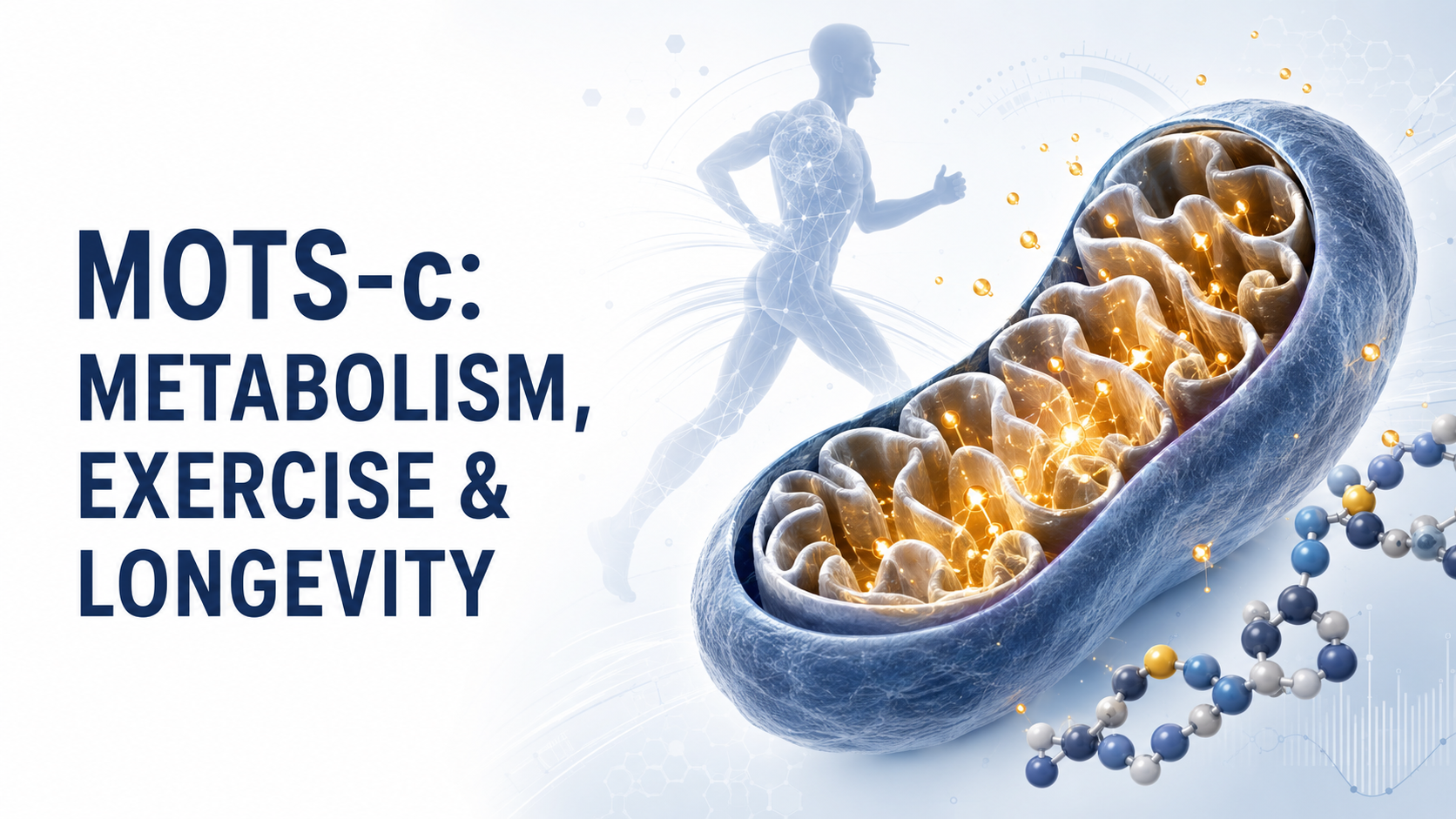
Summary: MOTS-c is a 16-amino-acid mitochondrial-derived peptide associated with metabolic signaling and exercise adaptation. Animal studies have reported effects on insulin sensitivity, obesity, muscle, and physical performance, while human research has largely measured naturally occurring MOTS-c rather than testing MOTS-c as a drug. PCAC recommended MOTS-c-related bulk substances for possible 503A listing in July 2026; final FDA action remains pending. Restorative Compounding Pharmacy + Wellness does not currently compound or dispense MOTS-c. A favorable PCAC recommendation is not FDA approval or immediate authority to compound.
Key takeaways
MOTS-c is encoded within mitochondrial DNA and participates in cellular stress and metabolic signaling.
Strong interest comes from animal studies involving insulin sensitivity, obesity, muscle metabolism, and exercise.
Human observational studies do not prove that injecting synthetic MOTS-c improves health.
FDA evaluated MOTS-c for obesity and osteoporosis.
FDA reported no identified human exposure data for MOTS-c drug products.
PCAC voted favorably, but the legal and clinical status has not been finalized.
What is MOTS-c?
MOTS-c stands for mitochondrial open reading frame of the 12S rRNA type-c. It is a 16-amino-acid peptide encoded by a short open reading frame within mitochondrial DNA.
Mitochondria are best known for energy production, but they also communicate with the rest of the cell. MOTS-c is part of a developing field examining mitochondria-derived peptides as stress and metabolic signals.
FDA evaluated MOTS-c free base and MOTS-c acetate as distinct bulk substances.
How is MOTS-c proposed to work?
The 2015 discovery paper reported that MOTS-c affected folate and purine metabolism, increased AICAR, and activated AMPK, a cellular energy-sensing pathway. In mice, administration improved insulin sensitivity and reduced high-fat-diet-associated metabolic dysfunction.
Researchers have also examined:
nuclear translocation during metabolic stress;
antioxidant and adaptive stress responses;
glucose uptake in skeletal muscle;
mitochondrial-to-nuclear signaling;
exercise adaptation;
inflammatory and age-related pathways;
muscle atrophy signaling.
These mechanisms are biologically compelling, but clinical benefit requires human interventional evidence.
What benefits is MOTS-c commonly promoted for?
weight management and fat loss;
improved insulin sensitivity;
metabolic health;
exercise endurance;
muscle preservation;
recovery and energy;
healthy aging and longevity;
bone health;
cardiovascular health.
MOTS-c is not FDA approved for these uses.
What does the research show?
Metabolism and obesity
The landmark mouse and cell study described MOTS-c as a regulator of metabolic homeostasis and reported protection against diet-induced obesity and insulin resistance in mice: Lee C, et al. The Mitochondrial-Derived Peptide MOTS-c Promotes Metabolic Homeostasis (https://pubmed.ncbi.nlm.nih.gov/25738459/). Results in mice do not establish human weight-loss efficacy. Human obesity involves different doses, exposure, comorbidities, medications, and long-term outcomes.
Exercise and muscle
Research has associated endogenous MOTS-c with exercise and metabolic adaptation. A study in breast-cancer survivors found relationships between exercise-associated MOTS-c levels and changes in body composition and insulin resistance: Dieli-Conwright CM, et al. Effect of Aerobic and Resistance Exercise on MOTS-c (https://pubmed.ncbi.nlm.nih.gov/34413391/). This does not show that administering synthetic MOTS-c reproduces exercise. Animal research also reported reduced myostatin and muscle-atrophy signaling: Kumagai H, et al. MOTS-c Reduces Myostatin and Muscle Atrophy Signaling (https://pubmed.ncbi.nlm.nih.gov/33554779/).
Aging and longevity
MOTS-c has been connected to stress resilience, age-related metabolic change, and longevity-related pathways. The phrase “longevity peptide,” however, can imply proven extension of human lifespan or healthspan. No adequate human trial has established that synthetic MOTS-c extends life.
Bone research
FDA evaluated osteoporosis in addition to obesity. The available record included preclinical information, but controlled human evidence for fracture prevention or osteoporosis treatment was not established.
What did FDA find?
FDA reported:
no applicable USP/NF monograph;
no FDA-approved drug component containing MOTS-c;
no identified human exposure data for MOTS-c drug products;
chemistry and characterization challenges;
potential peptide impurities and aggregation;
insufficient evidence of effectiveness for nominated uses;
uncertainty regarding immunogenicity and human safety.
FDA staff recommended against inclusion. PCAC made a favorable recommendation. Read the FDA MOTS-c briefing document (https://www.fda.gov/media/193347/download).
What did PCAC’s vote change?
PCAC recommended MOTS-c-related substances for possible inclusion on the 503A Bulks List. It did not prove MOTS-c causes weight loss, replaces exercise, treats osteoporosis, or extends lifespan. It also did not authorize immediate pharmacy compounding.
Potential safety and quality concerns
lack of human drug-exposure data;
unknown short- and long-term adverse effects;
possible immune response;
impurities, degradation, or aggregation;
sterile-preparation risks;
unknown metabolic interactions;
effects in cancer, pregnancy, autoimmune disease, and organ dysfunction;
lack of validated dosing or monitoring;
confusion between endogenous blood levels and drug administration.
Frequently asked questions
Is MOTS-c naturally produced by the body?
MOTS-c is a mitochondrial-derived peptide found in biological systems. A synthetic drug product administered at pharmacologic exposure is not equivalent to normal endogenous production.
Is MOTS-c a weight-loss medication?
No MOTS-c product is FDA approved for weight loss. Animal data are interesting, but human efficacy has not been established.
Does MOTS-c improve exercise performance?
Preclinical and observational evidence supports research interest, but controlled human drug trials are needed.
Is MOTS-c available from compounding pharmacies?
PCAC’s vote alone did not authorize compounding. Final FDA action and compliance with federal and state law remain necessary.
References
FDA. MOTS-c-Related Bulk Drug Substances Briefing Document (https://www.fda.gov/media/193347/download).
Lee C, et al. The Mitochondrial-Derived Peptide MOTS-c Promotes Metabolic Homeostasis (https://pubmed.ncbi.nlm.nih.gov/25738459/).
Dieli-Conwright CM, et al. Effect of Exercise on MOTS-c (https://pubmed.ncbi.nlm.nih.gov/34413391/).
Kumagai H, et al. MOTS-c Reduces Myostatin and Muscle Atrophy Signaling (https://pubmed.ncbi.nlm.nih.gov/33554779/).
FDA. July 2026 PCAC Meeting (https://www.fda.gov/advisory-committees/advisory-committee-calendar/july-23-24-2026-meeting-pharmacy-compounding-advisory-committee-07232026).